
2015 - 2
Proactive Absence Management
Absence costs money! In 2013 the UK alone lost 131 million work days due to sickness (UK Office of National Statistics). CBI in 2013 estimated the cost of absence in the UK to be £14bl. Now most companies’ approach to absence is to cover it at overtime, or having extra staff on shift to cover for an absence. Some companies even ignore the problem in the hope that if they don't manage it, it will go away. This is the most expensive option because what you don't control has a habit of running wild.
Having extra staff on shift is not only expensive but also reduces productivity and leaves shift managers continually firefighting. When we have reviewed company’s productivity against the number on shift we have found that if there are too many people for the work then less work gets done.
"Too many cooks spoil the broth!"This is because no manager likes to see a worker standing around doing nothing. Plus no one likes to stand around doing nothing, it’s demoralizing, tiring and everyone who is working will hate you for it. So the manager will reorganize the work to suit the number of people there. This takes time and is not as efficient as if you always have the correct number available.
Furthermore most companies never estimate the number who will be absent off shift correctly. They only use averages which are misleading, leaving most companies correctly staffed on only about one third of shifts (by using averages). On about two thirds of shifts they are either wasting money or losing money. So we created an approach which ensures that an operation always has the correct number of staff and only the correct number of staff on shift every shift.

Proactive Absence Management is about tackling absence head on. Most companies have no absence strategy, and those that do invariably use discipline and overtime to minimize the effect. This is both expensive and negative. Therefore our approach is to first of all estimate absence. So we look at historical data. The simplest statistic is Absence rate. Then using Dr Angela Moore’s statistical model (http://www.amazon.com/dp/B00S583GA0/) we can predict not only how much absence will occur but predict how many will be off each shift.
E.g. if you have a 2.5% Absence Rate and 10 people using a shift pattern which scheduled them to work on 260 days/shifts per year you would expect to see; On 202 days you would expect no one to be absent. On 52 days per year you would expect one person to be absent and on six days per year you would expect two people to be off. Hence you can plan your absence procedures on a maximum of two people being off because it is highly unlikely that three people would be absent on the same day. So we set up the shift pattern to give two people on-call or two cover shifts each day to cover for absence.
Ideally we would suggest using a holidays included shift pattern to maximize efficiency and minimize disruption to the operation. Then suggest that Banked Hours is used to provide the absence cover at basic rate not overtime rates. Obviously if you can cover the absence at basic rate this is cheaper than overtime, so there is a year on year significant cost saving.
The result of this is that absence is covered in house at basic rate to minimize cost and ensure that the best people are there to maximize productivity. The procedures are created up front so that shift managers are not left firefighting day in day out. The shift workers never have to worry that they will be under or over staffed on shift, and this minimizes stress. The shift workers also have a shift pattern that gives them a good work/life balance. Oh and as a bonus if the Banked Hours system is operated correctly some companies can see a significant fall in their absence rate.
If you would like us to help you be proactive towards absence please contact us via email: alec@oranalysts.com or call for more information 0044 (0) 1636 816466

How can you have 12-hour shifts on a 37.5 hour week?
The other day I was telling one of my friends about my day. I was happy because I’d been working on a holidays included shift pattern, which can be so much fun to create. There is so much potential with the way that the shifts can be organised, so you can create shift patterns that help people have a better work/life balance. You get to think about when and how people can take a holiday and how they would like to work shifts.
So I was telling her that a 37.5 hour week with 12-hour shifts means that they get loads of time off. Then she said “How can you have 12-hour shifts on a 37.5 hour week?” Well that threw me. I didn’t know what she was asking till she explained “12 doesn’t go into 37.5.”
Then it hit me, she was looking at a shift pattern through her experiences on an office hours arrangement. It was a question that loads of my clients have asked me in the past too, but I never understood what they were asking. In the past I just showed my clients the math and you can’t argue with math. However I never really explained, so let me now.
The length of the shift has nothing to do with the contracted hours per week. I know that statement doesn’t make much sense but it’s true. When I create a shift pattern I do not come at it from the perspective I have so many hours how do I organise them. I come from the angle of what work do I have to do. Then organise the shifts around the workload.
The length of the shift is contingent on;
- The type of work required,
- The legal constraints,
- The staff’s expectations and restrictions,
- The company’s rules,
- The workload requirements.
I take all of these into consideration and create the shifts to match the workload while ensuring that none of the shifts are too long or too short. The contracted hours don’t come into my calculations at all.
Once I have the workload covered with the shifts, I then use the contracted hours to calculate how many staff are needed in each skill to cover the workload. If you would like to know how to calculate the number of people your operation requires then read my ebook available now from Amazon:
UK Amazon: http://www.amazon.co.uk/gp/product/B008R8OUWQ
US Amazon: http://www.amazon.com/gp/product/B008R8OUWQ
So how can you have 12-hour shifts on a 37.5 hour week? You use averages!
A year has 52.14 weeks, therefore each person will work 1,955 hours per year. Using 12-hour shifts that’s 163 shifts or 3 per week on average. Using 8-hour shifts that’s 244 shifts or 4 or 5 shifts per week. You can do it with any shift length. The length of the shift has nothing to do with the contracted hours per week.
This is true within normal parameters, so for example if you made the shifts five hours long, nobody could do their contracted hours because they would need to work more than one shift per day. Plus it would make for a really awful shift pattern.
So if you want to go to 12-hour shifts but think like my friend that you can’t because 37.5 doesn’t divide by 12, don’t worry you can. Some weeks they will work 2 shifts, some weeks, 3 or 4, or 5, and then some weeks they will work none. The average over the year will be 37.5 hours per week. But in any particular week they will not be working 37.5 hours.
So here is a 12-hour shift pattern that gives an average over the year of 37.5 hours per week. Yet some weeks they work no hours. Some weeks they work 24 hours and in other weeks they work 60 hours.
This is based on the 232 shift pattern and very popular with shift workers.
If you would like help moving to a 12-hour shift operation then please contact us to find out more email alec@visualrota.co.uk or call us on +44 (0) 1636 816 466
Contingency Planning
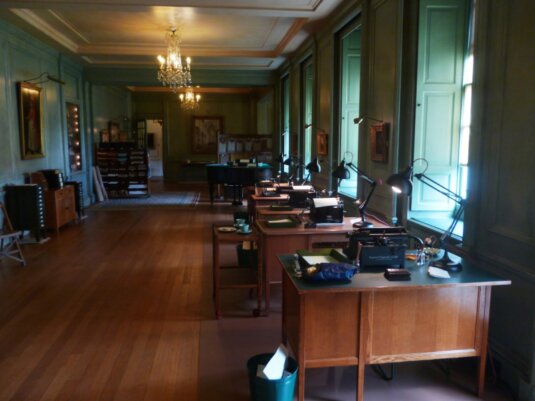
Have you recently visited Upton House in Oxfordshire? This year they have completely transformed the house to Banking for Victory. In 1939 the Bearsteds who owned Upton House moved out and their family-owned bank moved in. They needed to protect their staff and assets from the London air raids so moved Samuel & Co. lock, stock and barrel for the duration of the Second World War.
In the exhibition you can see how the bank staff lived and worked in the 1940s. The long gallery has been turned into a typing pool and the bedrooms have been set up for the bank staff that slept 2-4 to a room.
This is one example of the extremes contingency planning can take. How do you cope during war where your head office is in danger of bombing?
Now there are more threats than just bombing and important work must go on. We have helped a bank to set up their alternative base of operations. This ensured that in the event of any calamity they could operative effectively. Their alternative fully operational base was a replica of the original, so that their workers could seamlessly move from one location to the other.
There was a cost associated with this contingency plan including that the alternative base needed staff to maintain the premises. So we set up the technicians shift pattern to ensure that the Bank could always carry on operations regardless.
This sort of contingency planning is not new. The contingency planning process can be broken down into three simple questions:
• What is going to happen?
• What are we going to do about it?
• What can we do ahead of time to get prepared?
Everyday Contingency Planning
We also help companies with the less glamorous and extreme contingency planning. Everyday most companies will face; absence, sickness, holiday leave and tardiness. We help companies ensure that these everyday events do not affect their operation.
Recently the crash that occurred on the M9 on 5th July which resulted in two deaths went unattended for three days even through a call was taken by the 101 service. Part of the problem appears to be that the call centre was experiencing an over 10% absence rate. An ex-employee described the situation as: "a firefighting exercise and you were doing, say, 10 tasks probably half as well as you could actually manage, because you were trying to get so much done."
Very often staff, where there is no formal cover arrangement, feel like they are ‘firefighting’. To some it is exciting, every day is different. But for the majority it is stress that is unnecessary. So let’s go back to the three questions of contingency planning.
What will happen is absence. We cannot avoid absences. We can go further and assess how often and in what quantity absences will occur.
What are we going to do about it is a harder question to answer. It depends on budget, skill mix, staffing numbers and workload. In general we advocate covering for the absence. If you maintain a consistent level of service you will have a better operation. Even if that level of service is lower than you would like, a consistent service is better in the long run. That way every day is the same and you can focus on improvement rather than spending your time ‘firefighting’.
Reduction in the Number of Tea Ladies
Just in case you were wondering why tea ladies and not tea person, it’s a quote from Yes Minster the Economy Drive.
A tea break is great for keeping you healthy and productive. Keeping yourself hydrated is another way of keeping yourself alert and reducing sickness. When you are dehydrated you will feel tired and have a headache. Neither of which will make you work well. Over long periods, dehydration will have more serious health risks. One of which is that dehydration effects our immune system so when I’m around people with colds I always drink more in an effort to reduce my risk of catching it. When you are dehydrated or are talking a lot your throat feels dry, your mucus in your nose and throat dries up and cracks, this allows germs to pass more freely into the body. When you are hydrated your mucus is sticky and germs get caught. Have you ever noticed how your throat can get scratchy before you catch a cold? Incidentally I always drink camomile tea during flu season, I have read studies showing that camomile tea helps your immune system.*
False Economy
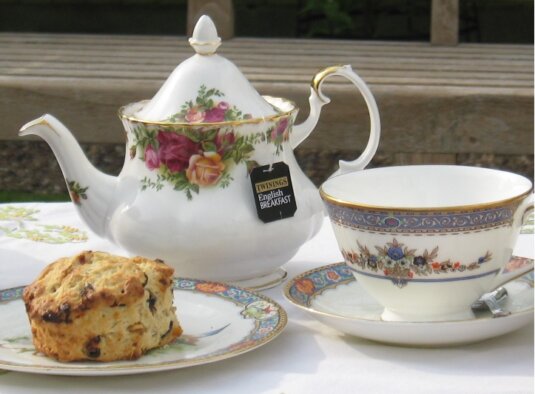
So I think that reducing the number of ‘tea ladies’ is a false economy. Firstly: have you ever thought about the time it takes to make a cup of tea? Well to make a proper cup of tea takes a minimum of six minutes. And that doesn’t include the time it takes to walk to and from the kitchen. Secondly: it takes just as long to make one cup of tea as to make two, or three. There is a limit based on the size of your kettle. Thirdly: a cup of tea helps to keep you hydrated. Hence you want to make it as easy as possible, to have a cup of tea.
The “Tea Break” has been a part of the British working culture for over a hundred years. Although now, it is just as likely to be a coffee break, or smoothly break or my favourite a hot chocolate break. When you have a break from work, it allows you to recoup and brings your fatigue levels back down. In my ebook Fatigue and Shift Work, I discuss the finding from several studies on the importance of breaks to minimise fatigue. One study in 1995 by Rogers et al** found that breaks returned the subjects to almost the same competence as when they first started working. Hence having regular breaks can actually make you more productive.
So a tea break is good for productivity and working effectively. Hence should be encouraged in the work place. It is also good for moral too. Who wouldn’t like a boss that insists everyone stops for a tea break?
Encourage Tea Breaks
So if you want to encourage tea breaks, then having a person come along with a cup of tea regularly is a great way to do it. Now a tea person would earn minimum wage, it can be the lowest skilled person in your company. It could even be a person on work experience, so even cheaper. So if you could employ someone cheaper, who could do the job of making a cup of tea better than you (making more than one cup of tea at a time is more productive), why wouldn’t you?
So how do you make the perfect cup of tea? Well I’m a tea drinker and so have spent a lot of time researching and experimenting to make that perfect cup of tea. For me it takes about six minutes. I am not a dunk-tea-bag-in-mug-add-hot-water-squeeze-with-spoon kind of girl. If you enjoy drinking dish water then great, if on the other hand you want to truly experience a good cup of tea then read on.
The Perfect Cup of Tea
My sister and I are both tea drinkers but we can’t agree on the best way to make a cup of tea. Incidentally she was recently on BBC radio Nottingham for National Cream Tea Day to explain how to make the perfect cup of tea. In her opinion it has to be made in a teapot and you drink it out of a china cup. I, on the other hand, disagree. You can make a very nice cup of tea from a teapot and if there is more than two people drinking, I will use a teapot. However if there is only one of you drinking then the tea can over stew unless you continually add hot water or have a fancy teapot with an infuser to stop the tea getting stewed. If you are busy at your computer, it is very easy to forget about your tea unless it is right in front of you. A teapot is impractical for work. You can make just as good a tea in a mug but you have to allow it time.
Presentation
To make a cup of tea, first think about how you are presenting it. With any food or beverage the first taste is with our eyes, the second with our nose and the third with our tongue. So if you want people to enjoy the tea don’t use a tea stained chipped mug! Mugs are not that expensive, get something decent for the office, porcelain is always nicer because it’s thinner and more delicate. However this can also be impractical at work unless you keep your mug on your desk and are very careful about washing it up. If you want to remove tea stains, I use a baking soda paste.
Just Add Water?
Now, making the tea, first don’t use boiling water, it tends to burn the tea leaves. The same when making coffee, don’t burn it. If you go to Italy, you will notice that they bring you your coffee at drinking temperature, and it tastes so much better for it. You want it around 90oC, so catch it before the water boils. Then add the tea bag to the mug and pour over the water. Do not try to add the tea bag to a mug of water. It doesn’t allow the tea to defuse well. (I love the part in a Second Best Marigold Hotel where this is explained.)
Now the tea you want will dictate how you brew it. If you want a regular black tea then think about the flavour. If you don’t burn the leaves the flavour really comes out. Personally I enjoy Assam, it has a good strong flavour. If you like ‘builders’ tea’ then try Assam, you do get a better flavour. My sister prefers the delicate flavour of Lady Grey with just a hint of citrus. But that’s the joy of a good cup of tea, you can enjoy different flavours. And always read the instructions on the packet. I know this may seem strange but they do tell you what will work best with the blend. Twinnings Tea are particularly good at making suggestions like drinking it black or with a dash of milk or if you should use lemon to enhance the flavour. Most teas should be brewed for about three minutes before you remove the tea bag.
With or Without Milk?
Now when it comes to adding milk, first let the tea brew, then remove the tea bag before adding the milk. This is very important and will greatly enhance the flavour. In the past the milk was always added to the cup first and then the tea was added. This was because if you were using very delicate porcelain the hot tea could crack it and stain it. This is no longer an issue. Especially if you are brewing in a teapot. After three minutes with non-boiling water even your fine antique china will not crack.
Other Teas
Now besides regular black teas, there are also, herbal, fruit, white, and green teas. Herbal teas are not just for hippies, camomile is great when you want to help your immune system and I also drink it if I have a headache. Mint tea is very refreshing, and helps your digestive system. I like to drink it after food or in the evenings instead of caffeinated tea.
Green and white teas are very good for you because of antioxidants. Personally I like to scare the tea bag with the water (pour the water over and then quickly remove the bag) so that I don’t get that bitter after taste. Fruit teas can be wonderful, there you really do get that first taste with your nose. They always smell divine.
Incidentally coffee always smells better than it tastes, because smell effects our taste buds. When you have a cold everything tastes bland not because your taste buds stop working but because our sense of smell is inhibited. The smell of coffee coming into the nose is more pleasant to us than the smell coming out while we are drinking. So it can leave you feeling a little disappointed. I add some chocolate and have a mocha, then you get the lovely aroma of coffee and the pleasant rich bitter flavour of the chocolate. Best of both worlds.
If you want a fruit tea or herbal, I always leave the bag in the mug. I prefer it stronger, but five minutes is normally sufficient to enjoy the flavour.
How to Remove the Bag
Now when it comes to removing the bag from the mug, NEVER under any circumstances give into the urge to squeeze the tea bag with the spoon. Instead try to gently lift the tea bag out. You really will get a better flavour.
Sugar?
Oh and if possible avoid adding sugar. If you don’t like the flavour of the tea on its own, with milk or lemon, try a different tea. Don’t just go on mindlessly trying to disguise the taste with sugar. It could be that you are burning the leaves so you have to add sugar to cover the bitter burnt taste.
There is of course one exception and that is the ultimate pick me up when you have a cold. I make a large teapot of tea with one bag of ginger and lemon tea and one of camomile tea. I then add a large tablespoon of honey to the pot (after three minutes so that it has brewed). Then I add one whole lemon sliced up to the pot. Then curl up on the sofa with a hot water bottle and a blanket. Drink the whole pot and repeat as required.
Bring Back the Tea Ladies
So I say bring back the tea ladies and laddies. Enjoy your tea break with pride and reduce your absence rate, increase your productivity and maximise your potential.
If your operation is too small for a tea person, then set up a rota. Take it in turns to make everyone a cup of tea. Whenever I want a cup of tea I always ask everyone else if they would like one too. You’ll soon become the most popular person in your office. People associate things in their minds, it’s how we remember. So if you are responsible for making everyone feel happy, alert and productive, they will start to associate these feeling with you.
If you enjoyed this blog, then please share it with others.
Prime Day
Since its Prime Day, I thought I would blog about the decline of the office Library.
In the past most companies had a library. It was a great place to go; do some research, get away from it all and read a book or just find some peace and quiet. However with the proliferation of the internet, companies no longer use libraries. You can now do all your research on line, get the latest news and magazines right at your desk so why do you need a library?
Libraries are expensive; the books, space and librarians all start to add up. So if there ever was an easy cost cutting exercise, then let’s get rid of the company library is right up there next to reduction in tea ladies. Personally I think getting rid of tea ladies is a false economy but I’ll save that for another blog.
However I do think we have really lost something with the decline of the library. In the past the company library was the only place to go if you wanted to know about anything and read the professional journals and text books. Going there was great, firstly I was always one of the few people who knew it existed. So the only other people you met there were like minded; liked books, interested in learning and knew the value of a good book. So you automatically had something in common with everyone and then you could exchange ideas over a coffee. If you are doing research then you can discuss problems with others and find solutions that you never would have come up with on your own. But a library is about more than the people going there it’s about books!
With the internet the information could be OK and genuine or it could be there today gone tomorrow. There is a time and a place for internet research and while it is good for a broad search, after that I prefer a book. A book doesn’t change, it will always be the same. It has an author and will normally be checked by experts in the field so the chances are that it will be correct. This is not necessary true, I remember reading a book on queuing theory and thinking that the equation just didn’t make sense. So I went back to the university library and got the references for the book. Followed it back till I found the original book with the original equation. And the explanation showed that there was a typo, a minus instead of a plus. Everyone else had just copied it without understanding.
But this just shows you the power of a library. Everything in one place, so if you don’t understand one explanation, follow the references and find somebody else’s.
So what do we do now? I think that we should have the office bean bag and kindle! That way you can still enjoy a sit down with a good book, yet not have the wasted space. A library in one small tablet.
Be different, start a new trend. Get a kindle library for your office. And if you are wondering what books to fill it with, may I recommend mine: Calculating How Many Staff Do You Need, Holiday Management, Holidays Included Shift Pattern, Fatigue and Shift Work, Banked Hours, Understanding your Absence Rate.

The French 10-day Week
Did you know that during the French Revolution they changed the week to being 10 days?
The French Republican Calendar was used by the French government for about 12 years from late 1793 to 1805. It was designed to remove all religious and royalist influences from the calendar, and was part of a larger attempt at decimalisation in France. They divided the month into three décades or 'weeks' each of ten days.
Shame the year has 365 1/4 days per year. That doesn’t divide by anything. Must have been a pain trying to keep trach of everyone’s Birthdays as each year the months would move.
Still at least the French were logical in their names for the days of the week: First Day, Second Day etc. Where as in English the days of the week are derived from the planets of Hellenistic astrology, in the order Sun, Moon, Mars (Ares), Mercury (Hermes), Jupiter (Zeus), Venus (Aphrodite) and Saturn (Cronos). Then the Norse Gods needed to be represented too so Tuesday in Old English was Tīwesdæg Tiw was a one-handed god in Norse mythology. Wednesday in Old English was Wōdnesdæg the Germanic god Wodan was an Anglo-Saxons god. Thursday in Old English Þūnresdæg. Þunor means thunder and the Norse god of thunder is Thor hence Thor’s day. Friday in Old English Frīgedæg referring to the Anglo-Saxon goddess Fríge. Fríge was a goddess like Venus.
However if everyone else is working a 6 day week (seven days and one rest day) and you are working a 9 day week (10 days and one rest day), then you can produce 5% more using the same labour force.
This is what shift work is all about, using your resources more intensely. Then you can produce, sell or create more that your competitors in the same time frame.
What we do is take your workload, then create a shift pattern that creates the best work life balance possible while ensuring that you have the right people, at the right time, in the right place, with the right skills.
This will create an efficient system to maximise your production while minimising your costs.
If you would like us to help you with your production please contact us. If you would like a shift pattern review why not use our Business Health Check package.

The Secret to Creating an Efficient, Low Cost, Shift Schedule
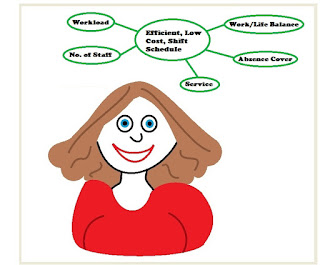
Five key components to ensure an efficient, low cost, shift schedule which also gives the shift workers a good work/life balance?
Understand the workload. The workload is key whenever you are creating a shift operation. Your employees are there to cover the work. So you only want them there when there is work for them to do and you want them in the right place, at the right time, with the right skills.
Employ the correct number of staff. There is no point in employing too few. In the long run that just leads to high overtime and agency costs. Now you can’t save your entire overtime and agency budget but if you employee people at basic rate it will normally be a lot cheaper.
What type of service do you need to provide. All companies are different, and want different things, sometimes it’s continuity of operations, for others it’s meeting SLAs, minimising costs, maximising productivity, maximising output, maximising profits
A shift pattern for a good work/life balance. So you need to think about fatigue, time off, commutes, length of shifts, etc.
Absence costs money. A lot of money. So you need a way of covering for absence, be that holidays, sickness or authorised leave. The best way to cover absence is in-house, because your own staff will always know your operation, equipment and staff better than an outsider. Also it is normally cheaper.
If you would like to know more about creating an efficient, low cost shift operation which ensures a good work/life balance for your staff, then contact us directly to find out more.
Happy 4th July
How to cope when everyone wants the day off!
There are days when everyone wants the day off. The most popular is Christmas Day, but special holidays (4th July) are still popular. So what do you do when everyone wants that day off?
You have lots of options, but first ask yourself can you shut down your operation on key dates? If you can then do. Shutdowns are a great way to use up everyone annual leave and make everyone feel happy. Of course most shift operation do not have that luxury. They run 24 hours a day, 365 days a year. So they can’t shut down. So you have to ensure that those key dates are fairly distributed.
Options include:
· Run longer shifts on that day to minimise the number who are inconvenienced
· Run shorter shifts so that everyone is inconvenienced but everyone get to enjoy part of the day with their family
· Ask for volunteers
· Give people a bonus for working that day
· Give them two days off in lieu for working that day
· Do alternate years, so if you work it this year, you won’t work it next year
· Run a skeleton crew
You could even think out of the box, so have a celebration at work and encourage your staff to invite their families. Then have everyone alternate between celebrating and working. Or if you can’t have visitors on site, why not set up a video link in the break room so that your staff can chat on line to their family during their break.
Happy 4th July

How will Wimbledon effect your operation?
Whenever there is a popular sporting event, people want to watch it. And seeing it later is just not the same. People like to support their favourites or just watch in appreciation of a game well played. Do you have sporting calendar? Then you will you know when these events will affect your staff; the world cup, rugby league, test matches, local derbys, X factor finals, Olympics, local matches, county shows, the Open, etc.
This inevitably leads to more people wanting time off so they can watch the game live. Especially when we are enjoying some rarely seen nice weather. So everyone wants a holiday at the same time. You can’t give everyone the same time off unless you close up your business with a shutdown. But how do you say no to that holiday request? Who do you say yes to and how do you justify your answers?
Being a manager is not easy. You have to have patience, be seen to be fair, make the hard choices and stick by them as well as doing the job you are paid to do. You can never be liked by everyone and people’s opinion of you will be swayed by your next decision depending on if it is in their favour or against them.
So don’t let personal feelings cloud your judgment. Make up a set of rules which cover nearly every eventuality you can think of. Make sure everyone is aware of what you will and will not allow and stick to it. That way you will not always be liked but everyone will always say you dealt fairly with them.
When it comes to allowing holidays it is even more important to judge everyone the same and not let personal bias effect your judgment. So you set up rules like first come first served. Plan ahead how many of each skill you will allow off at any time or how you will cover missing skills. Set up the rules before any holiday requests are made. If you need help setting up your rules then read our book Holiday Management available from Amazon UK and from US Amazon
So if you think that Wimbledon will cause a lot of holiday requests, think about how you are going to deal with them. And if all else fails, can you have a TV on in the break room or book your holiday now and let your deputy deal with it?